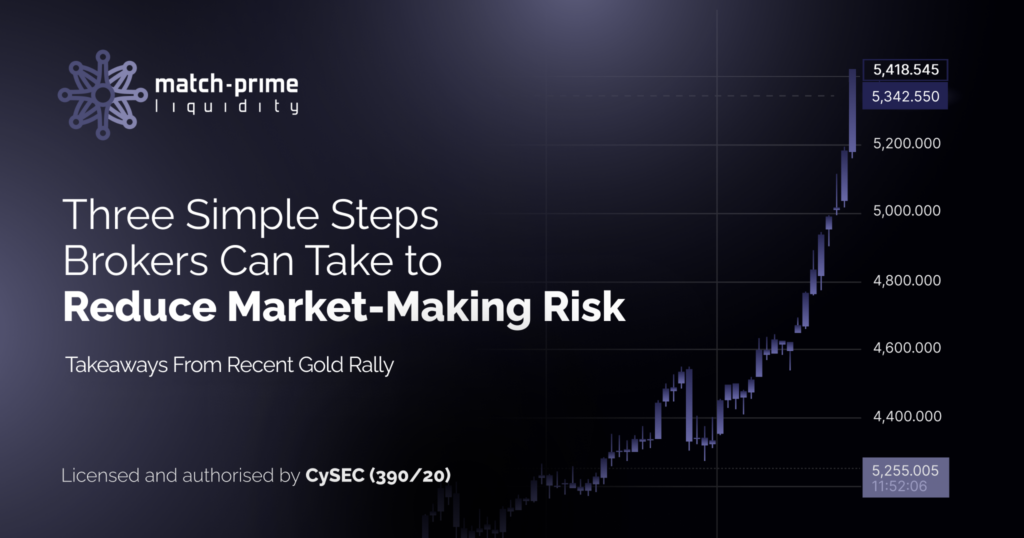
The recent gold rally and its violent reversal reminded the industry what high-volatility regimes actually feel like. For brokers running market-making operations, the past few months exposed familiar vulnerabilities – many of them preventable.
At Match-Prime, we work with brokerages across the full spectrum: from early-stage operations to large, established industry players. Despite the differences in scale, certain patterns repeat. The same structural issues can cause disproportionate damage when markets move sharply – and too often, the fixes are simpler than they appear.
Differentiate Your Leverage by Client Tier
A significant contributor to broker losses during the gold rally was the use of uniform leverage rules applied regardless of account size. A client depositing $1,000 might receive the same terms as a client depositing $100,000.
In practice, a $1,000 account trading at 500:1 leverage can cause serious problems. Using the same leverage on a $100,000 account leads to identical risks – only magnified 100 times.
Reviewing your activity from late 2025 through January will show whether this was the case. If it was, consider revisiting how leverage is structured for different categories of clients. Large clients are valuable, but they can be retained on different terms. The alternative – letting them take positions that could threaten your own capital base – is a risk no brokerage can afford to accept.
Stop Siloing Your Dealing Desk
Too many brokerages treat their dealing desks as a necessary support function rather than a core part of the business.
Senior executives and owners are understandably focused on the commercial side, including deposits, acquisition channels, and conversion rates. These are visible, measurable, and directly linked to growth.
The dealing desk, by contrast, operates in the background and is easily forgotten until a crisis hits. But every commercial commitment a brokerage makes – every spread, every leverage ratio, every instrument offering – ultimately runs through the dealing desk. It is the engine that everything else depends on.
When commercial terms are set without input from the people managing the resulting risk, brokerages can end up requiring their trading teams to carry exposure that is structurally unsustainable. Treating the dealing function as an integral part of commercial decision-making – not a back-office cost center – is the first step toward aligning business ambitions with the risk they actually generate.
Agree on a Plan Before You Need One
One of the most common gaps we see is in brokerages where owners or C-level executives have no concrete, documented agreement on risk management policies within their own firm.
The consequences are predictable. During a rally, dealing desks get questioned for not hedging enough. When the market reverses and other brokers profit from their B-book positions, those same dealing teams are asked why they gave away so much flow to their liquidity provider.
Having documented risk management policies solves several problems at once. At a minimum, it ensures that senior management understands what the dealing desk is doing and why. It also provides a reference point when trading decisions are questioned and creates consistency in how the business responds to stress.
The January gold crash brought that difference into sharp focus. Dealing desks with clear policies in place knew how to respond – even under difficult conditions. Where they were absent, desks had to improvise. That improvisation costs money. Over time, it also creates friction between staff members and erodes trust within the organization.
Prepare Before the Next Shock
The recent gold episode is unlikely to be the last. Periods of market stress will continue to recur, and each one reveals how well, or how poorly, a brokerage’s risk framework aligns with its commercial ambitions.
Reducing market-making risk is less about predicting the next move and more about building a structure that can absorb it. That means clear limits, aligned incentives, and decision-making processes that remain effective when prices move fast.
None of this needs to be unnecessarily complex, but it does need to be deliberate. Firms that treat periods or relative calm as an opportunity to refine their setup will find that when volatility returns, they are managing a plan rather than reacting to a crisis.